

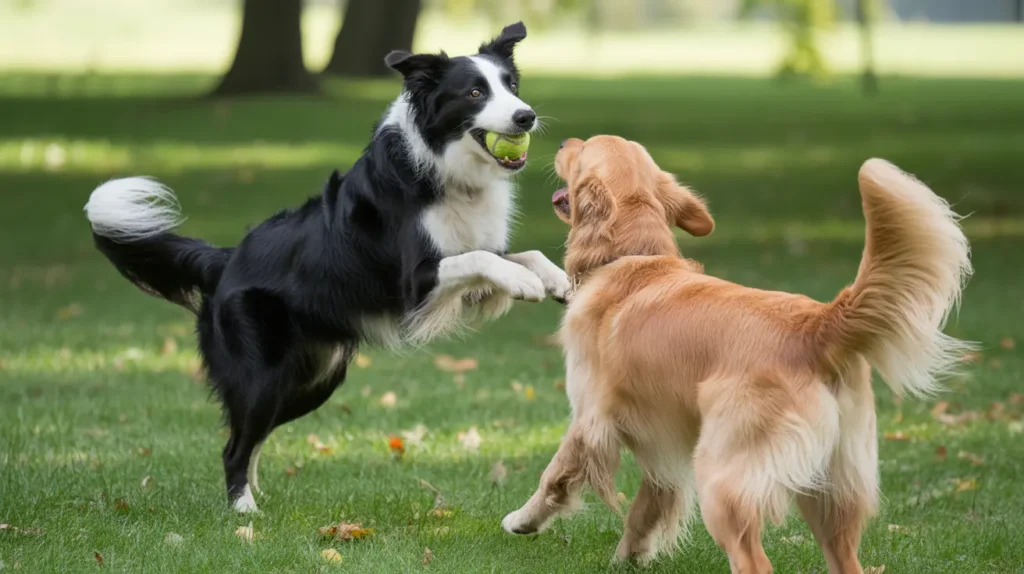
Play is a vital part of a dog’s life. Through social play in dogs, they learn social skills, communication, limits, and build positive bonds with others (humans and canines). For many dog owners, knowing how to play with dogs in a safe, rewarding way is a core concern. Good play also reveals a lot about dog play behaviour: what dogs enjoy, how they signal, when things go too far. In this guide, we will cover:
- When is social dog play okay?
- What is appropriate dog social play?
- Signs of ‘inappropriate’ dog social play
- Tips for safe dog play and how to safely interrupt
- Why you can’t simply “let dogs sort it out themselves”
- Preparing your dog for social play
- Managing ongoing social play
- Special focus: how do dogs play with humans, and why do dogs like to play with humans
Much of the foundational structure is informed by the Greencross Vets article “A Guide To Social Play
When Is Social Dog Play Okay?
Social play in dogs is a natural behavior, but not every interaction labeled “play” is safe or healthy. One useful starting point is the Greencross Vets notion that rather than imposing human judgments, we should let the dogs’ own body language and signals “do the talking.”
Social dog play is “okay” when:
- The participants are comfortable, relaxed, and showing reciprocal turns in “winning/losing” roles
- The play is balanced (not one-sided dominance)
- Dogs can self-handicap (tone down intensity when one is smaller or less experienced)
- They use signals to clarify intent (e.g. play bow)
- The arousal remains moderate (not excessive)
- They take natural breaks or pauses
- They respond to each other’s signals (e.g. backing off when partner seems uncomfortable)
When these criteria are met, play can be highly beneficial. It builds confidence, teaches bite inhibition and social courtesy, release of energy, mental stimulation, and social bonding.
If those criteria aren’t met—if play becomes overly rough, one dog is avoiding or stressed, or things escalate—it’s time to intervene.
What Is Appropriate Dog Social Play?
To characterize appropriate dog social play, here are features to look for (as summarized in the Greencross article
- Reciprocity: Dogs should take turns being dominant or submissive, “winning” or “losing.”
- Self-handicapping: A physically stronger dog should reduce intensity (bite less hard, move more gently) when playing with a smaller or younger dog.
- Announcing intention: Use of the “play bow” (front down, rear up) is a classic invitation, signaling that what follows is play, not aggression.
- Low to moderate arousal: Dogs should not get too wild, frantic, or hysterical.
- Pauses and breaks: Natural stops, short rest intervals, or mutual breaks help reset and check in.
- Responsive to signals: If one dog shows signs of stress or wants to back off, the other should be able to slow or stop.
Some of the signs of relaxed, happy play to look for:
- Loose, wiggly bodies, relaxed muscles
- Bounce, turning, spinning, switching between standing and play positions
- Willingness to be rolled or “caught”
- Gentle mouth contact, pawing, hip bumps
- Invitational postures (bows)
- Open, loose mouths (not tight lips)
- Occasional vocalisations (playful growls, barks)
- Breaks or pauses in between bursts of action
These behaviors contrast with stiff, tense, closed-mouth postures or continued mounting, overpowering contact, freezing, or avoidance — those are warning signs of inappropriate or escalating play (see below).
Understanding dog play behaviour in this way helps you recognize when a session is healthy and fun, and when it might cross the line.
What Are the Signs of ‘Inappropriate’ Dog Social Play?
Recognizing when play has gone wrong is just as important as encouraging good play. Some signs that social play is becoming problematic include:
- Stiff, rigid postures or freezing
- Sustained dominance: continuous body-slamming, mounting, pawing, or one dog always overpowering
- A dog trying to escape, hiding, or avoiding
- Displacement behaviors: scratching, sniffing, eliminating, as a sign one dog is overwhelmed
- Tight, closed mouths, lips curled, snarling
- Sharp, low growls, high-pitched barking, or snarling
- Lack of reciprocation (one dog always dominating)
- No natural breaks or pauses in play
If you see these, it’s a signal to intervene. Don’t assume “they’ll sort it out” — especially in a dog park or unfamiliar context, things can escalate quickly.
How Can I Safely Interrupt Social Play Between Dogs?
When you see play going off the rails or approaching danger, you’ll need to step in. But interruption must be done carefully to avoid making the situation worse, scaring a dog, or creating negative associations with your intervention. Here are tips for safe dog play interruption (adapted from Greencross) :
- Recall / call your dog: Use a known cue (e.g. name, “come”) to draw your dog’s attention away. Reward their compliance so recall is positive.
- Lure away: Use treats or a toy to attract the dog’s attention and simultaneously lead them away from the other. This is especially useful if contact is up-close (face-to-face).
- Body block: When safe, step between the dogs to break their visual/physical connection temporarily. Use this brief pause to lure or guide them apart.
- Detach carefully: Once separated, attach a lead if possible, walk them apart, and engage in calm cues (sit, down) to help them reset.
- Pause & reset: After separation, give both dogs a cool-down period. If they calm down (loose body, relaxed posture), you may allow them to re-engage. If not, end play.
The key is to be calm, deliberate, and non-punitive. You are not scolding—just guiding the interaction to stay safe and fun.
Why Can’t I Just Let Dogs Sort It Out Themselves?
One might think it’s natural for dogs to negotiate their own conflicts. In many cases, they do. However, there are several reasons why we, as owners or guardians, need to mediate:
- Dogs do not have perfect social skills. Even well-socialised dogs can misread signals or act too strongly.
- In modern environments, dogs are often constrained (on-leash, fenced parks), reducing their natural options to avoid or disengage.
- Without oversight, minor missteps can escalate into injury or trauma, leading to fear or aggression later.
- Negative outcomes can have long-lasting consequences in a dog’s future social behaviour.
- Owners have a responsibility to ensure safety, especially in settings with unfamiliar dogs.
The Greencross guide emphasizes that even the best-behaved dog can occasionally violate the rules of fair play, so human management is necessary to reduce risk and foster positive experiences.
Preparing Your Dog for Social Play
Before jumping into unsupervised play sessions, preparation is key. Here are steps you can take to build a foundation for healthy, mutual play:
- Early, controlled socialisation: During puppyhood, introduce your dog to a variety of dogs, environments, sounds, surfaces, people. Safe, gradual exposure builds confidence and social competence.
- Teach cues/recall: Commands like “look,” “come,” “leave it,” “sit,” etc., are invaluable. In a play situation, you must have a means to redirect your dog if needed.
- Learn body language: As a human, your ability to read canine signals is crucial. Understand stress cues, arousal levels, calming signals, etc.
- Start small: First play sessions should be short and with reliable, known dogs. Let them gradually build up energy and comfort.
- Control the environment: Use neutral ground (not a dog’s “territory”), avoid high-distraction settings, and ensure no valuables are around.
- Model calm leadership: Your dog should see you as a source of stability. If things escalate, they should look to you for guidance rather than panic.
These preparations give your dog a better chance at safe, joyful social play.
Managing Your Dog’s Social Play (Ongoing)
Once your dog is ready to participate, ongoing supervision and moderation are essential:
- Always supervise play, especially off-leash or with unfamiliar dogs
- Choose suitable playmates: Match by play style, energy, size, age. Avoid pairing a six-month-old Great Dane with a fragile Chihuahua. Greencross makes this point explicitly.
- Rotate breaks: Encourage rest intervals to let bodies cool and arousal reset
- Watch for escalation: Stay alert to posture changes, tension, signs one dog is over threshold
- Be ready to intervene using the safe interruption methods above
- End on good terms: If tensions rise, end before things escalate. Return to calm cues or leash removal for decompression
- Reinforce good play: Praise calm, balanced interactions; reward recall, self-control, breaks
Because dogs’ emotional states can shift quickly, never assume a fun session will remain so. Active oversight is the backbone of responsible dog social play.
How Do Dogs Play with Humans?
While much of the previous discussion focused on dog-dog play, interactions between dogs and humans are also highly meaningful—and understanding how to play with dogs (i.e. through human-dog games) is critical for a strong, mutually enjoyable bond.
Dogs generally play with humans using these forms:
- Chase / tug / fetch: Dogs love to chase thrown objects, run after moving items, and pull on objects (e.g. tug ropes).
- Hide-and-seek: You hide, dog seeks you, or you hide a toy and your dog searches.
- Gentle wrestling / body contact: Some dogs enjoy light play wrestling, pawing, head nudges—provided boundaries respected.
- Interactive toys: Puzzle toys, flirt poles, wand toys—these allow controlled play sessions.
- Training games: Turning training into play (e.g. “find it,” “go around,” obstacle games) blends mental engagement with fun.
When humans engage with dogs in play:
- Use clear signals to distinguish play vs serious contact (stop, pause, let dog rest).
- Avoid encouraging over-arousal or biting hands; instead use toys for contact.
- Monitor your dog’s energy and body language: if tension, stiff posture, avoidance, or lip licking appear, it’s a cue to slow or stop.
- Respect your dog’s preference: some dogs enjoy rougher play, some prefer gentler games.
Why do dogs like to play with humans?
There are several reasons:
- Bonding & social connection: Dogs are social creatures; play with humans strengthens trust and attachment.
- Mental & physical exercise: Play channels energy into fun, healthy activity.
- Reinforcement & reward: If play consistently brings positive feedback (attention, treats, praise), dogs will seek it.
- Mirror of pack behavior: In domestication, dogs have adapted play to include humans, using similar signals and cues.
- Mood and emotion regulation: Play can help relieve stress, boredom, frustration, and serve as a release.
Dogs see humans as social partners; by playing, they communicate, test boundaries, and enjoy companionship. Understanding how do dogs play with humans helps us provide better, safer, and more fulfilling play interactions.
Tips for Safe Dog Play (Summary)
Here’s a consolidated list of tips for safe dog play, combining all the above advice:
- Always supervise play, especially initially
- Match playmates by size, age, and style
- Begin sessions in low-distraction settings
- Reward recall and self-control with treats or praise
- Read body language for signs of stress or over-arousal
- Encourage breaks and pauses
- Intervene early (before escalation) using lures, body blocks, or recalls
- End play sessions before frustration or fatigue sets in
- Use toys or signals when playing with your dog to maintain boundaries
- Watch for signs of fatigue or overstimulation and respect them
By following these guidelines, you can greatly reduce risk, increase safety, and make play more rewarding for everyone.
Putting It All Together with Alvid Pet
If we introduce Alvid Pet (perhaps your brand, dog training center, or pet services provider), you can use all the above guidance as part of your content or educational offerings. For example:
- On your site or pamphlet, a “Guide to Social Play in Dogs (with Alvid Pet)” can teach dog owners how to play with dogs safely and responsibly.
- You can illustrate dog play behaviour using images and video, showing the difference between healthy and inappropriate play.
- Under a “Tips for Safe Dog Play” section, you can include the steps above (supervise, breaks, match partners, intervene tactfully).
- In a section “how do dogs play with humans & why dogs like to play with humans,” you can explain the various play modes between humans and dogs, and the social, psychological, and physical reasons behind it.
- You can also provide a “Preparing your dog for social play” & “Managing your dog’s social play” under your Alvid Pet services/training curriculum.
This allows potential clients or education-seekers to see that Alvid Pet is grounded in solid behavioral science and best practices.
Conclusion
Social play in dogs is a nuanced, powerful way for them to develop social skills, burn energy, strengthen bonds, and enjoy life. But it must be fostered carefully.
By learning how to play with dogs, interpreting dog play behaviour, applying tips for safe dog play, and understanding how do dogs play with humans (as well as why dogs like to play with humans), we can enrich the lives of our pets—and maintain safety and harmony in social settings.