

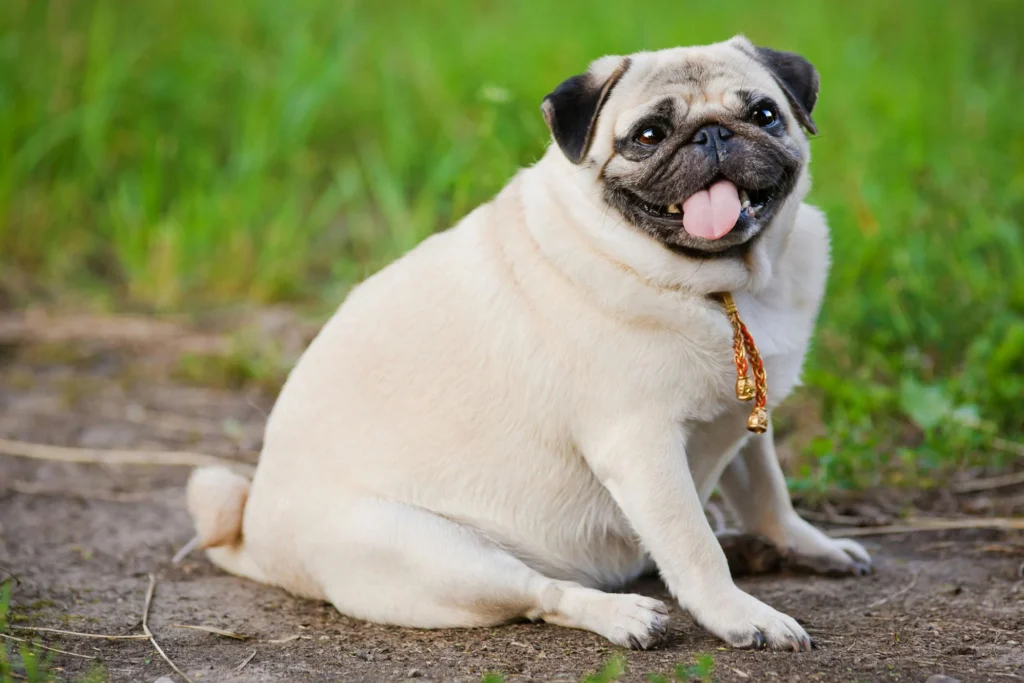
Dog obesity refers to the condition in which a dog carries excess body fat, to the point where health is compromised. Overweight in dogs is a milder version—dogs have more fat than optimal, but not yet so much that disease is certain. In practice, many dogs slide gradually from healthy weight into overweight, and then into obesity if nothing is done.
An overweight dog:
- Has fat deposits that can be seen or felt
- Moves less comfortably or shows reduced stamina
- May show early signs of health issues like joint problems, reduced immune function, or metabolic changes
Obesity is more severe: it increases risk of diseases like diabetes, heart disease, arthritis, certain cancers, and reduces lifespan. Recognizing where your dog stands is critical.
Signs and Symptoms of Overweight
Knowing “how to know if my dog is overweight?” starts with observing specific physical, behavioral, and health-related indicators. Here are the most common signs and symptoms of overweight in dogs:
- Rib Observation and Palpation
- You should be able to feel your dog’s ribs easily under a thin layer of fat. If you have to press hard to feel ribs, or cannot feel them at all, that’s a sign.
- If the ribs are clearly visible with very little fat covering, that’s underweight; if they are fully buried under thick fat deposits, that’s likely overweight or obese.
- You should be able to feel your dog’s ribs easily under a thin layer of fat. If you have to press hard to feel ribs, or cannot feel them at all, that’s a sign.
- Waist and Tuck Assessment
- When viewing your dog from above, there should be a visible waist or indentation behind the ribs. If the line from the ribs to the hips is flat or bulging outward, that’s a sign of overweight.
- From the side, you should see an abdominal tuck — the belly slopes up from the bottom of the ribcage to the thighs. Lack of this tuck suggests excess body fat.
- When viewing your dog from above, there should be a visible waist or indentation behind the ribs. If the line from the ribs to the hips is flat or bulging outward, that’s a sign of overweight.
- Difficulty in Mobility, Activity Drop
- Dogs that struggle to walk, climb steps, run, or play may be carrying excess weight. Overweight in dogs often leads to reduced stamina.
- Excessive panting after mild exercise can also be a symptom.
- Dogs that struggle to walk, climb steps, run, or play may be carrying excess weight. Overweight in dogs often leads to reduced stamina.
- Fat Deposits and Physical Changes
- Fat pads over the base of tail, hips, chest, and along the back.
- Loss of shape around the face or neck—jowls increase, neck thickens.
- Skin folds may become deeper; dog might have “muffin top” appearance.
- Fat pads over the base of tail, hips, chest, and along the back.
- Behavioral Signs
- Less interest in physical play.
- More time lying down or sleeping.
- Reluctance to jump, climb stairs, or go for walks.
- Less interest in physical play.
- Health Symptoms
- Difficulty breathing.
- Increased risk of heat intolerance.
- Joint pain or stiffness.
- Digestive issues or a decreased metabolic rate.
- Possible changes in blood sugar or lipids if overweight becomes obesity.
- Difficulty breathing.
If you see several of these signs, especially if your dog fits the criteria when you examine ribs, waist, activity, then likely your dog is overweight, advancing toward obesity.
Why Is My Dog Overweight?
Once you recognize the problem, the next question is why is my dog overweight? Multiple factors contribute:
- Overfeeding Calories
- Feeding more food than needed for daily energy expenditure.
- Using too many treats or table scraps.
- Meals portions are not measured.
- Feeding more food than needed for daily energy expenditure.
- Poor Quality Diet or Too Much Fat in Dogs Diet
- Diets high in fat and simple carbohydrates can lead to fat deposition if not balanced.
- Too much fat in dogs diet causes excess calorie intake.
- Diets high in fat and simple carbohydrates can lead to fat deposition if not balanced.
- Low Physical Activity
- Sedentary lifestyle, breed predisposition, age (older dogs move less), overweight making movement painful, thus a vicious cycle.
- Genetics and Breed Predisposition
- Some breeds are more likely to gain weight easily (Labrador retrievers, Beagles, Dachshunds, etc.).
- Some metabolic rates are lower by breed or individual hereditary factors.
- Some breeds are more likely to gain weight easily (Labrador retrievers, Beagles, Dachshunds, etc.).
- Life Stage Factors
- Neutering/spaying can shift metabolism, making weight gain more likely.
- Aging slows metabolism.
- Puppies have different needs: overfeeding a growing puppy can lead to unhealthy fat deposition and long-term health risks.
- Neutering/spaying can shift metabolism, making weight gain more likely.
- Medical Conditions
- Hypothyroidism, Cushing’s disease, hormonal issues.
- Medications may also promote weight gain.
- Hypothyroidism, Cushing’s disease, hormonal issues.
- Behavioral and Psychological Factors
- Food as reward or compensating for guilt/separation anxiety.
- Owner misinterpretation of hunger cues.
- Overfrequent treats or feeding because “my dog looks hungry” even when full.
- Food as reward or compensating for guilt/separation anxiety.
So when you ask “why is my dog getting fat,” these are the usual suspects. Strong possibility it is a combination: diet + low activity + breed + aging.
Puppies: Growth, Monitoring, and Prevention
Puppies have special nutritional and growth needs. When thinking about how much weight should puppies gain per week, it depends on breed, size-at-maturity, and growth curve. Overfeeding puppies to gain weight quickly is dangerous:
- Small breed puppies (expected adult weight under ~20 lbs / 9 kg): may gain around 5-10% of their current bodyweight per week in early weeks, slowing as they age.
- Medium to large breed puppies (expected adult weight ~20-60 lbs / 9-27 kg): similar percentage until about half adult size, then growth slows.
- Giant breeds: growth must be slower to avoid placing too much stress on bones and joints.
Veterinary growth charts by breed are best. If a puppy gains significantly more than expected, or develops round belly, difficulty moving, or visible fat deposits, that could be a sign of early overweight or fat accumulation. Thus, monitor weekly or biweekly, measure food portions, ensure balanced diet and provide enough exercise — age-appropriate.
My Dog Is Overweight — What to Do
If you’ve concluded that my dog is overweight, here’s what to do to help your dog come back to healthy weight, safely and sustainably.
- Veterinary Assessment
- Visit your veterinarian first. Rule out medical conditions (thyroid, hormonal, metabolic disorders) that might be contributing.
- Get baseline weight, body condition scoring (BCS), bloodwork if needed.
- Ask vet what weight target is appropriate.
- Visit your veterinarian first. Rule out medical conditions (thyroid, hormonal, metabolic disorders) that might be contributing.
- Dietary Adjustment
- Evaluate current diet: calories per cup, fat content, treat content.
- Replace high-fat treats with low-calorie alternatives (vegetables like carrots, green beans, etc.).
- Use measured portions. Stop free-feeding.
- Switch to a weight-management formula if recommended by vet, with lower calorie density, higher fiber to promote satiety.
- Evaluate current diet: calories per cup, fat content, treat content.
- Exercise Plan
- Increase physical activity gradually: more frequent walks, longer walks, play sessions.
- Swimming or low-impact activities if joints are stressed.
- Keep sessions fun and achievable; don’t push too fast.
- Increase physical activity gradually: more frequent walks, longer walks, play sessions.
- Monitor Progress
- Weigh the dog every 1-2 weeks.
- Observe body shape: ribs, waist, abdominal tuck.
- Track food intake, treat amounts.
- Weigh the dog every 1-2 weeks.
- Lifestyle Changes
- Reduce table scraps.
- Avoid feeding from the table.
- Use food puzzle toys, slow feeders to slow down eating and improve mental stimulation.
- Ensure rest and sleep are adequate.
- Reduce table scraps.
- Behavioral Training
- Train “leave it” for treats and foods off limits.
- Use rewards unrelated to food (toys, praise).
- Enlist all family members in consistent feeding and exercise routines.
- Train “leave it” for treats and foods off limits.
- Long-Term Maintenance
- Once ideal weight is reached, maintain with lower but adequate calories.
- Continue regular activity.
- Regular vet checkups.
- Once ideal weight is reached, maintain with lower but adequate calories.
How Much Weight Loss is Safe & Realistic
You shouldn’t aim for rapid loss. Like in people, fast weight loss can backfire. A safe rate for dogs is often around 1-2% of body weight per week, depending on starting weight, breed, health, and age. Vet will guide this.
Symptoms of Too Much Fat in Dogs Diet
Specific to symptoms of too much fat in dogs diet, here’s what you may notice:
- Digestive upset: oily stools, flatulence, diarrhea.
- Increased body fat secretion: visible oily films in fur, more dander.
- Skin issues: itchiness, poor coat, dryness or excess oils.
- Pancreatitis risk: high fat diets may trigger inflammation.
- Lifelong health risks: obesity, insulin resistance, lipidosis.
So if your dog is consuming a high-fat diet beyond what their metabolic needs are, these symptoms often accompany excess weight or precede obvious weight gain.
Signs and Symptoms of Overweight
Let’s summarize the signs and symptoms of overweight clearly, so you can compare with your dog:
| Area | What to Look For |
| Body Shape | No waist visible from above; belly doesn’t tuck; ribs buried under fat. |
| Fat Deposits | Fat pads over base of tail, hips, chest; thick neck, loss of definition. |
| Movement & Activity | Less willingness to move; tires out quickly; reluctance for stairs or play. |
| Physical Condition | Skin redness; coat issues; breathing difficulty; joint discomfort. |
| Behavior | Eats more than needed; treats often; always begging for food; sleeps more. |
| Growth in Puppies | Gaining weight too rapidly; heavy for age; shape rounding; joints bowing. |
If multiple items in this list apply, then your dog is very likely overweight.
How Much Weight Should Puppies Gain Per Week — More Detail
For those with puppies: growth must be monitored carefully. Rapid weight gain in young age can lead to issues like hip dysplasia, joint deformations, obesity later in life. General guidelines:
- For toy breeds: maybe 70-100 grams per week in early age, gradually tapering.
- For small/medium breeds: maybe several hundred grams per week depending on expected adult size.
- For large/giant breeds: slower growth; perhaps 1-2% of current body weight per week but less aggressive than small breeds.
Use growth charts from a trusted veterinary source. Adjust feeding if puppy is gaining faster than charts suggest. Puppies need diets rich in protein, balanced nutrients; avoid over-supplementing fats or calories just to “fatten up” a puppy beyond healthy norms.

Why Is My Dog Getting Fat — More Triggers
Let’s go deeper on why is my dog getting fat, beyond the obvious—many owners don’t realize contributing factors.
- Human food: Sharing table scraps, cooking for the dog with fatty sauces, oils. These add up.
- Marketing or misconceptions: Some believe “he looks skinny, I’ll feed more,” without realizing overnutrition.
- Inappropriate treats: Many treats have two to three times more calories per gram than dog kibble; multiple small treats can add more calories in total than a meal.
- Misreading feeding guidelines: Feeding based on package recommendations without adjusting for the dog’s individual needs, age, neutered status, or activity level.
- Neutering/spaying: Hormonal changes reduce caloric requirement; if feeding remains same, weight gain results.
- Age: Older dogs often less active, metabolic rate slows; diet must adjust.
- Illness or pain: If dog is in pain (e.g. arthritis), movement reduces, leading to weight gain.
- Inaccurate food measuring: Using cups, not weighing; using scoops loosely; human error.
Understanding these lets you diagnose what in your routine is tipping the scale.
How to Know if My Dog is Overweight? — A Practical Checklist
Here’s a step-by-step checklist you can use at home:
- Perform the rib-check: feel ribs with light pressure.
- View from above: is there a waist behind ribs?
- View from side: is the abdomen tucked up?
- Observe activity: does dog tire quickly, pant heavily, avoid stairs?
- Monitor eating and treat habits.
- Record current weight; check breeder or vet growth charts (for puppies) or ideal weight ranges.
- Compare past photos: has shape changed visibly?
If more than two–three items are clearly off, your dog is likely overweight, and action is needed.
My Dog Is Overweight — What to Do: Step by Step Plan
Putting everything into action:
- Define a goal weight with your veterinarian.
- Determine current caloric need: measure rest metabolic rate plus activity. Vet can help.
- Adjust feeding: reduce the calorie amount to create a modest deficit (often 10-20% less than maintenance, depending on health). Use feeding schedule instead of free-feeding.
- Choose diet wisely: high in lean protein; moderate healthy fats; fibers to aid satiety. Avoid diets heavy in fat unless healthier fats balanced in overall plan.
- Scale back high-calorie treats: count treats as part of daily calories. Use healthy alternatives.
- Increase activity gradually: daily walks, play, swimming, mental exercise. Make sure joints are okay.
- Track progress: weekly weigh-in; monthly body condition scoring. Adjust plan if dog losing too fast or too slow.
- Behavioral change: train owner and family to avoid overfeeding; avoid emotional feeding; avoid giving in to begging.
- Maintenance: once ideal weight is reached, find the maintenance calories, keep the same activity level, perhaps occasional re-checks with vet.
What If My Dog’s Overweight Situation is Severe?
If obesity has advanced:
- Risk of joint problems, heart strain, respiratory issues.
- Vet might recommend a veterinary weight management program or specialized prescription diet.
- In some cases surgery (e.g. for orthopedic issues) may be considered, but only as part of a broader plan.
Why Prevention Is Better Than Cure
Preventing overweight in dogs is far simpler than reversing it. Prevention is about:
- Feeding properly from puppyhood.
- Regular monitoring of body condition.
- Consistent exercise.
- Mindful treat use.
- Healthy feeding habits among all caregivers.
By preventing excessive breed-typical weight gain when young, you reduce risks later in life.
Conclusion
Overweight in dogs and dog obesity are serious issues that can significantly reduce quality of life and lifespan. To answer how to know if my dog is overweight, look for changes in body shape (ribs, waist, abdominal tuck), movement, behaviors, and overall coat and skin health. Understand why is my dog overweight by examining diet, exercise, age, metabolic or medical factors, and lifestyle. Know how much weight should puppies gain per week, avoiding overfeeding during growth stages. Watch out for symptoms of too much fat in dogs diet like skin problems, oily coats or stools, lethargy, etc. If my dog is overweight what to do, implement a plan: consult your vet, adjust feeding, add exercise, monitor progress, and make long-term lifestyle changes.
At Alvid Pet, we believe that responsible care, guided by awareness and consistency, can prevent obesity and ensure dogs enjoy longer, healthier lives. Saying goodbye to obesity starts with small, meaningful changes—changes that every pet parent can make today.